Volume Calculator: How to Calculate Volume for Any 3D Shape
A volume calculator lets you find the cubic measurement of any 3D shape — box, cylinder, sphere, cone, or pyramid — in seconds. Whether you're ordering concrete for a slab, sizing a water tank, filling a planter bed, or estimating how much gravel fits in a trailer, knowing the exact volume prevents over-ordering materials and saves hundreds of dollars on every project.
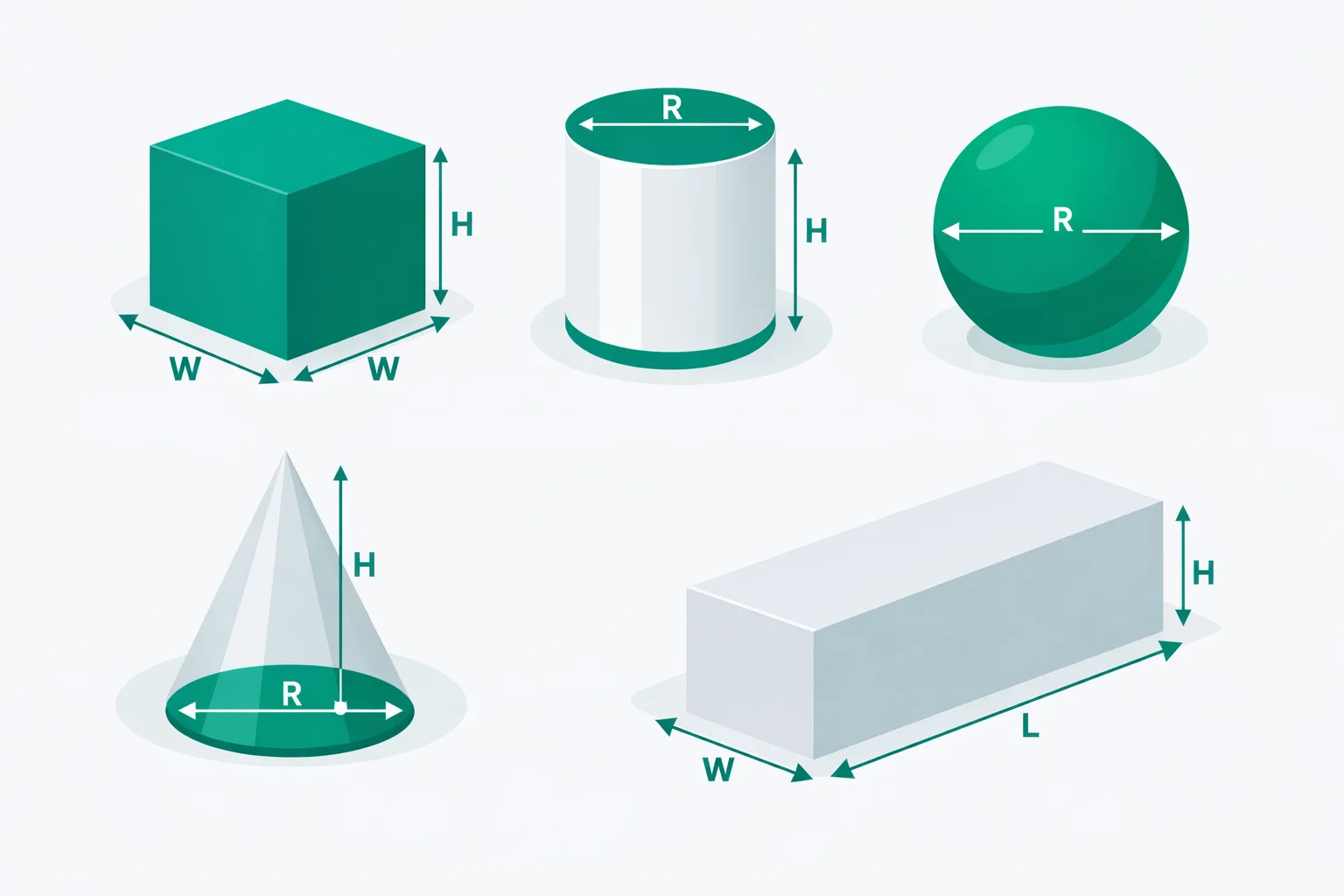
What Is Volume?
Volume measures the amount of three-dimensional space an object occupies. Unlike area, which covers a flat surface in two dimensions (length × width), volume adds a third dimension — height or depth. The result is expressed in cubic units: cubic feet (ft³), cubic yards (yd³), cubic meters (m³), or liquid units like gallons and liters.
In practical terms, volume tells you how much material fills a space or how much liquid a container holds. A room's air volume determines HVAC sizing. A planter's soil volume tells you how many bags to buy. A tank's water volume tells you its gallon capacity. Every construction, landscaping, and home improvement project involves at least one volume calculation.
Volume Formulas for Common 3D Shapes
Each 3D shape has its own formula. Here are the five most useful ones for home projects:
- Box / Rectangular Prism: V = Length × Width × Height — used for rooms, garden beds, concrete slabs, and storage containers.
- Cylinder: V = π × r² × h — used for round tanks, pipes, well casings, and tree trunk estimates.
- Sphere: V = (4/3) × π × r³ — used for spherical tanks, balls, and dome calculations.
- Cone: V = (1/3) × π × r² × h — used for conical piles of sand, gravel, and soil.
- Pyramid: V = (1/3) × Base Area × Height — used for hip-roof attic spaces and tapered structures.
Notice that a cone is exactly one-third the volume of a cylinder with the same base and height, and a pyramid is one-third the volume of a box with the same base and height. This relationship is useful for quick mental estimates.
Worked Examples with Real Dimensions
Example 1 — Raised garden bed (box):A bed that is 8 feet long, 4 feet wide, and 1.5 feet deep has a volume of 8 × 4 × 1.5 = 48 cubic feet. Divide by 27 to get 1.78 cubic yards of soil. At $35–$50 per cubic yard for topsoil, that's roughly $62–$89 in material.
Example 2 — Round water tank (cylinder): A tank with a 2.5-foot radius and 4-foot height holds π × 6.25 × 4 = 78.54 cubic feet. Multiply by 7.48 to get 587 gallons — enough for a modest rainwater harvesting system.
Example 3 — Gravel pile (cone): A conical pile with a 5-foot base radius and 3-foot height contains (1/3) × π × 25 × 3 = 78.54 cubic feet, or about 2.91 cubic yards. At $20–$30 per yard for pea gravel, that pile is worth $58–$87.
If you already know the area of your space and just need to calculate it first, use our area calculator to find the 2D footprint before multiplying by depth.
Converting Between Volume Units
Volume conversions come up constantly when comparing product sizes, ordering materials, or interpreting specs from different countries:
- Cubic feet → Cubic yards: Divide by 27. Bulk materials (concrete, gravel, mulch) are sold by the cubic yard.
- Cubic feet → US Gallons: Multiply by 7.48052. Essential for tank sizing and water volume.
- Cubic feet → Liters: Multiply by 28.3168. International products often list capacity in liters.
- Cubic feet → Cubic meters: Multiply by 0.0283168. Used in scientific and international construction contexts.
- Cubic yards → Cubic feet: Multiply by 27. One cubic yard fills a space 3 ft × 3 ft × 3 ft.
Common Volume Reference Sizes
Knowing common volumes helps you sanity-check calculations before ordering materials:
- Standard bathtub: 40–80 gallons (5.3–10.7 ft³)
- 55-gallon drum: 7.35 ft³ — a common benchmark for rainwater barrels
- Pickup truck bed (full-size, level): about 2.5 cubic yards (67.5 ft³)
- Concrete mixer truck: 8–10 cubic yards (216–270 ft³)
- Standard 10 × 10 × 8 ft room: 800 ft³ of air volume
- Above-ground pool (15 ft round, 4 ft deep): approximately 5,288 gallons (706.9 ft³)
For land-area conversions rather than volume, our square footage calculator handles multi-room measurements with instant unit conversion.
Volume for Construction and Material Orders
Volume calculations drive material purchases in nearly every construction and landscaping project. Here are the most common scenarios and the waste factors professionals add:
- Concrete slabs and footings: Calculate the exact cubic yards needed, then add 5–10% for waste and spillage. A 10 × 12 foot patio at 4 inches deep requires 10 × 12 × 0.333 = 40 ft³ ÷ 27 = 1.48 yd³. Order 1.6 yd³ to account for waste.
- Mulch and topsoil: Measure the bed area in square feet using our acre calculator for large plots, multiply by desired depth, and convert to cubic yards. A 200 sq ft bed at 3 inches deep needs 200 × 0.25 = 50 ft³ ÷ 27 = 1.85 yd³.
- Gravel and fill dirt: Add 10–15% for settling and compaction. Loose gravel compacts by about 10–15% after spreading and settling.
- Water tanks and pools: Convert cubic feet to gallons (multiply by 7.48) to match pump and filter ratings, which are specified in gallons per hour.
Common Mistakes When Calculating Volume
- Mixing units: Entering length in feet and depth in inches without converting first is the most common error. Always convert all dimensions to the same unit before multiplying. A 4-inch slab depth is 0.333 feet, not 4 feet — that mistake inflates your order by 12×.
- Using diameter instead of radius: Cylinder and sphere formulas require the radius (half the diameter). Using the full diameter quadruples the result because the radius is squared or cubed.
- Forgetting compaction: Loose materials like gravel, soil, and mulch compress 10–15% after settling. A 2-cubic-yard delivery of topsoil may only cover 1.7–1.8 cubic yards once compacted.
- Ignoring irregular shapes:A room with an alcove or a lot with a curved edge isn't a simple rectangle. Break complex shapes into simpler ones, calculate each separately, and add them together.
Tips for Accurate Volume Calculations
- Measure twice, calculate once. Take two independent measurements of each dimension and average them. Uneven surfaces (like sloped ground) can vary by several inches across a span.
- Use a laser distance meter for large spaces. They are accurate to ±1/16 inch over 100+ feet and cost $25–$50 for a basic model.
- Always add a waste factor. For concrete: 5–10%. For loose fill (gravel, mulch, soil): 10–15%. For liquids (pools, tanks): calculate to the exact gallon since there is no waste.
- Convert dimensions before calculating, not after. It is easier and more accurate to convert 4 inches to 0.333 feet before plugging it into the formula than to convert the final answer.
- Sketch the shape on paper and label each dimension before entering values. This prevents mixing up length, width, and height, especially on complex projects.
When to Use This Calculator
- Ordering bulk materials: Determine cubic yards of concrete, gravel, mulch, topsoil, or sand before placing a delivery order.
- Sizing tanks and containers: Convert cubic feet to gallons or liters to match product specs for water tanks, rain barrels, and storage vessels.
- Estimating project costs: Multiply volume by per-unit material cost to get a budget estimate before visiting the supply store.
- HVAC and air volume: Calculate room air volume to size heating, cooling, and ventilation systems properly.
- Shipping and storage: Determine the cubic footage of items to choose the right container size or estimate freight costs.