Trapezoid Calculator: How to Measure Area and Perimeter for Lots, Roofs, and More
A trapezoid calculator lets you find the area and perimeter of any four-sided shape that has one pair of parallel sides. If you own an irregularly shaped lot, need to estimate roofing material for a non-rectangular section, or are working through a geometry problem, this tool gives you instant answers in square feet, square meters, and acres — no manual math required.
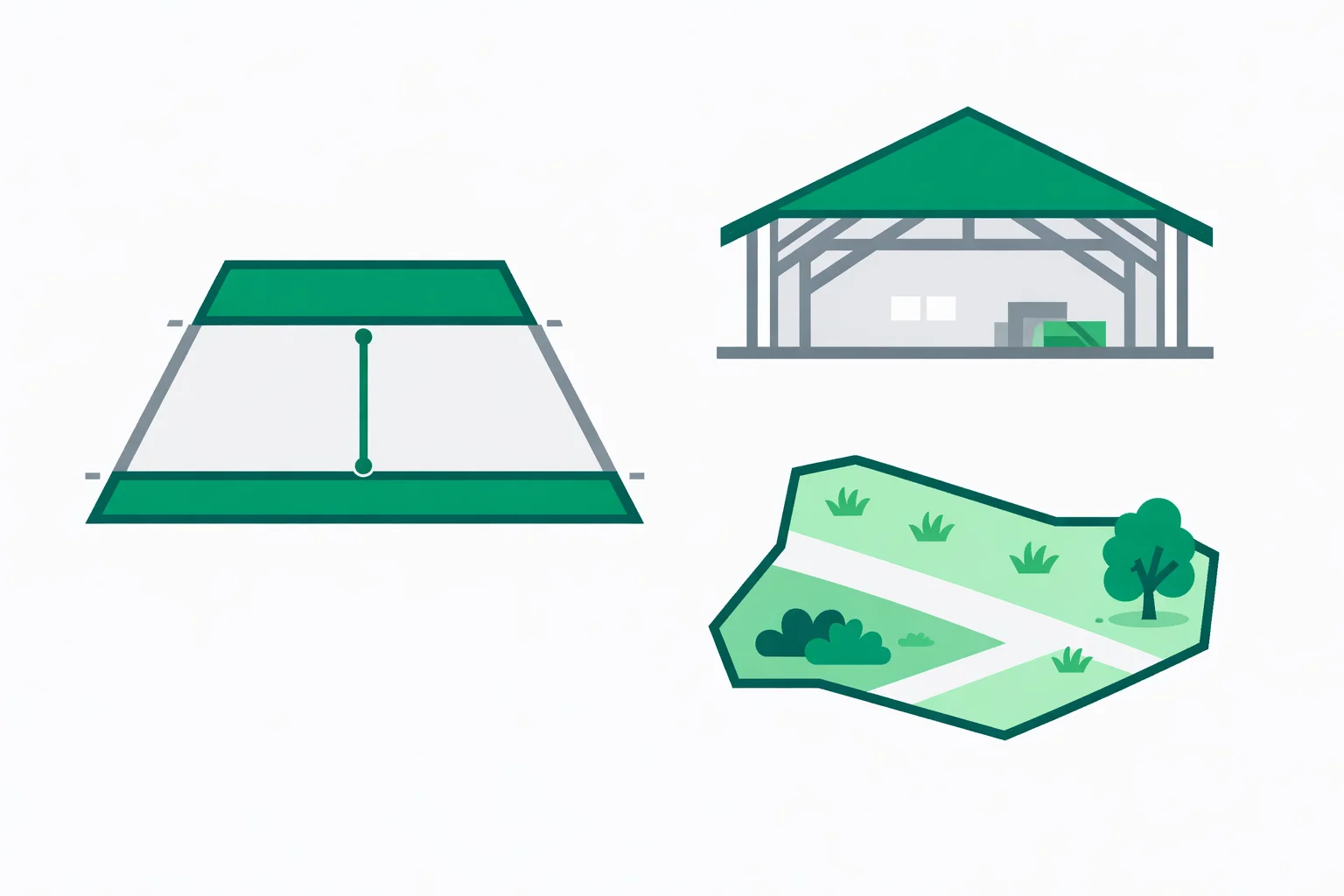
What Is a Trapezoid?
A trapezoid (called a trapezium in British English) is a quadrilateral with exactly one pair of parallel sides. The parallel sides are called bases, and the non-parallel sides are called legs. The perpendicular distance between the two bases is the height.
Trapezoids appear everywhere in the real world: property lot lines that narrow toward the back of a parcel, roof sections on hip roofs, retaining wall cross-sections, and driveway aprons that widen from the garage to the street. Recognizing when a shape is a trapezoid is the first step toward measuring it accurately.
The Trapezoid Area Formula Explained
The formula for the area of a trapezoid is:
Area = (Base 1 + Base 2) ÷ 2 × Height
This works because a trapezoid's area equals a rectangle whose width is the average of the two bases. Take a lot where the front boundary is 100 feet, the back boundary is 70 feet, and the depth is 150 feet: (100 + 70) ÷ 2 × 150 = 85 × 150 = 12,750 square feet, or about 0.29 acres. Compare that to a perfect rectangle of 100 × 150 (15,000 sq ft) — the narrowing back boundary reduces the area by 2,250 sq ft, which could mean $10,000–$30,000 less in land value depending on the market.
If you need to calculate square footage for rectangular rooms instead, the standard length × width formula applies. But for any shape with two different-length parallel sides, the trapezoid formula is the correct approach.
How to Find the Perimeter of a Trapezoid
The perimeter is the total length around the outside of the trapezoid:
Perimeter = Base 1 + Base 2 + Side A + Side B
If you only know the bases and height, you need to calculate the leg lengths first. For an isosceles trapezoid, each leg equals √(height² + ((Base 1 − Base 2) ÷ 2)²). For a right trapezoid, one leg equals the height, and the other leg equals √(height² + (Base 1 − Base 2)²).
Perimeter matters when you're installing fencing around a trapezoidal yard, adding trim to a trapezoidal wall section, or calculating material for edging around a garden bed. A lot with bases of 80 ft and 120 ft and legs of 55 ft each has a perimeter of 80 + 120 + 55 + 55 = 310 linear feet of fencing.
Types of Trapezoids: Right, Isosceles, and Scalene
Knowing which type you have helps you measure correctly:
- Right trapezoid: One leg is perpendicular to both bases (forms a 90° angle). Common in roof sections and wall cross-sections. The perpendicular leg equals the height.
- Isosceles trapezoid: Both legs are equal in length. The shape is symmetrical. Common in decorative architecture, garden beds, and tabletop designs.
- Scalene trapezoid: All four sides are different lengths. This is the most common type for irregular land lots where no two boundaries match.
The area formula is the same for all three types — only the perimeter and diagonal calculations change based on leg lengths.
Trapezoid Measurements for Land Lots and Property
Many residential lots are trapezoids because streets curve or parcels were subdivided unevenly. To measure a trapezoidal lot:
- Identify the two most parallel boundaries — typically the front (street-facing) and back property lines
- Measure each boundary length (these are your two bases)
- Measure the perpendicular distance between them (the depth of the lot, measured at a right angle — not along a side boundary)
- Apply the formula: (Front + Back) ÷ 2 × Depth = Area
To convert to acres, divide the square footage by 43,560. Use our acre calculator for quick conversions between square feet, acres, and hectares.
A common scenario: Your lot has a 90-foot front boundary and a 65-foot back boundary, with a depth of 130 feet. Area = (90 + 65) ÷ 2 × 130 = 77.5 × 130 = 10,075 square feet (0.23 acres). A rectangular lot of the same front width and depth would be 11,700 sq ft — so the trapezoidal shape costs you 1,625 sq ft of usable space.
Worked Examples with Real Dimensions
Example 1 — Driveway apron:A driveway widens from 12 feet at the garage to 24 feet at the street, with a 20-foot length. Area = (12 + 24) ÷ 2 × 20 = 18 × 20 = 360 square feet. At $8–$12 per square foot for concrete, that's $2,880–$4,320 for materials.
Example 2 — Roof section:A hip roof creates a trapezoidal face with a ridge of 20 feet (top), an eave of 36 feet (bottom), and a slant height of 14 feet. Area = (20 + 36) ÷ 2 × 14 = 28 × 14 = 392 square feet. With a 10% waste factor, order at least 431 sq ft of shingles for that section.
Example 3 — Garden bed:You want a garden that's 8 feet wide at one end, 5 feet wide at the other, and 12 feet long. Area = (8 + 5) ÷ 2 × 12 = 6.5 × 12 = 78 square feet. At 1 cubic foot of topsoil per square foot at 4 inches deep, you need 78 × 0.33 = about 26 cubic feet (roughly 1 cubic yard) of soil.
Common Mistakes When Measuring Trapezoids
- Using a slant side instead of height:The height must be perpendicular to both bases. If you measure along the sloping side, your area will be too large. A 15-foot slant side on a lot where the true height is 14 feet gives a 7% error — that's 900+ sq ft on a 12,000 sq ft lot.
- Swapping base and height: The bases are the two parallel sides; the height is the distance between them. Plugging in a side length where the height should go produces a wrong answer.
- Forgetting to average the bases:Using only the longer base (length × width) overestimates the area. For a lot with a 100 ft front and 70 ft back, using just 100 ft overestimates by 18%.
- Not checking if the shape is truly a trapezoid: If neither pair of opposite sides is parallel, the shape is an irregular quadrilateral, not a trapezoid. In that case, split it into triangles and calculate each separately, or use our general area calculator for other shapes.
Trapezoid Quick-Reference Table
Use this table to quickly estimate trapezoid areas for common residential dimensions:
| Base 1 (ft) | Base 2 (ft) | Height (ft) | Area (sq ft) | Acres |
|---|---|---|---|---|
| 50 | 35 | 80 | 3,400 | 0.078 |
| 75 | 60 | 100 | 6,750 | 0.155 |
| 100 | 70 | 130 | 11,050 | 0.254 |
| 120 | 90 | 150 | 15,750 | 0.362 |
| 150 | 100 | 200 | 25,000 | 0.574 |
| 200 | 150 | 300 | 52,500 | 1.205 |
When to Use This Calculator
- Measuring a property lot where the front and back boundaries are different lengths — most cul-de-sac and pie-shaped lots are trapezoids
- Estimating roofing material for trapezoidal roof faces on hip roofs, dormers, and asymmetric gable ends
- Planning a driveway or walkway that widens or narrows, such as an apron connecting a narrow garage to a wider street
- Calculating garden bed or patio area for material orders — soil, pavers, mulch, and gravel all require accurate square footage
- Homework and geometry problems — enter the bases and height to verify your manual calculations instantly