Acre Calculator: How to Measure and Convert Land Area in Acres
An acre calculator converts land dimensions or area measurements into acres, the standard unit for measuring property and farmland in the United States. Whether you're evaluating a real estate listing, splitting a rural parcel, or estimating how much fencing you need around a pasture, knowing the exact acreage saves you from costly guesswork — a 10% error on a 5-acre lot can mean overpaying by thousands of dollars.
What Is an Acre?
An acre is a unit of land area equal to 43,560 square feet. The word comes from the Old English "æcer," originally meaning the amount of land a yoke of oxen could plow in one day. Today, the acre is the standard land measurement in the U.S., U.K., and several other countries.
Unlike a foot or a meter, an acre has no fixed shape — it can be a square (roughly 209 × 209 feet), a long rectangle (660 × 66 feet), or any irregular shape as long as the total area equals 43,560 sq ft. This is important for real estate because property parcels are rarely perfect rectangles.
How to Calculate Acreage
The formula is straightforward:
Acres = (Length × Width) ÷ 43,560
Both length and width must be in feet. If you measured in other units, convert to feet first: multiply yards by 3, meters by 3.281, or miles by 5,280.
Worked example: A rectangular field measures 500 feet long by 350 feet wide. The total area is 500 × 350 = 175,000 square feet. Divide by 43,560 to get 4.02 acres. That is about the size of three football fields side by side.
Second example: A smaller suburban lot measures 120 feet by 80 feet. That is 9,600 square feet ÷ 43,560 = 0.22 acres — just over one-fifth of an acre, which is typical for many suburban neighborhoods.
For lots that aren't rectangular, break the shape into simpler sections, calculate each area in square feet, add them together, and then divide by 43,560. Use our square footage calculator to calculate the individual sections quickly.
Acres to Square Feet Conversion
Below is a quick-reference conversion table for the most commonly searched acreage values:
| Acres | Square Feet | Square Meters | Hectares |
|---|---|---|---|
| 0.25 (¼ acre) | 10,890 | 1,012 | 0.101 |
| 0.50 (½ acre) | 21,780 | 2,023 | 0.202 |
| 1 | 43,560 | 4,047 | 0.405 |
| 2 | 87,120 | 8,094 | 0.809 |
| 5 | 217,800 | 20,234 | 2.023 |
| 10 | 435,600 | 40,469 | 4.047 |
| 40 | 1,742,400 | 161,874 | 16.187 |
| 100 | 4,356,000 | 404,686 | 40.469 |
| 640 (1 sq mi) | 27,878,400 | 2,589,988 | 259.0 |
To convert any acre value: multiply acres by 43,560 for square feet, by 4,046.86 for square meters, or by 0.4047 for hectares. For the reverse — square feet to acres — simply divide by 43,560.
Acre Size Comparisons
Because 43,560 square feet is hard to picture, here are real-world comparisons to help visualize an acre:
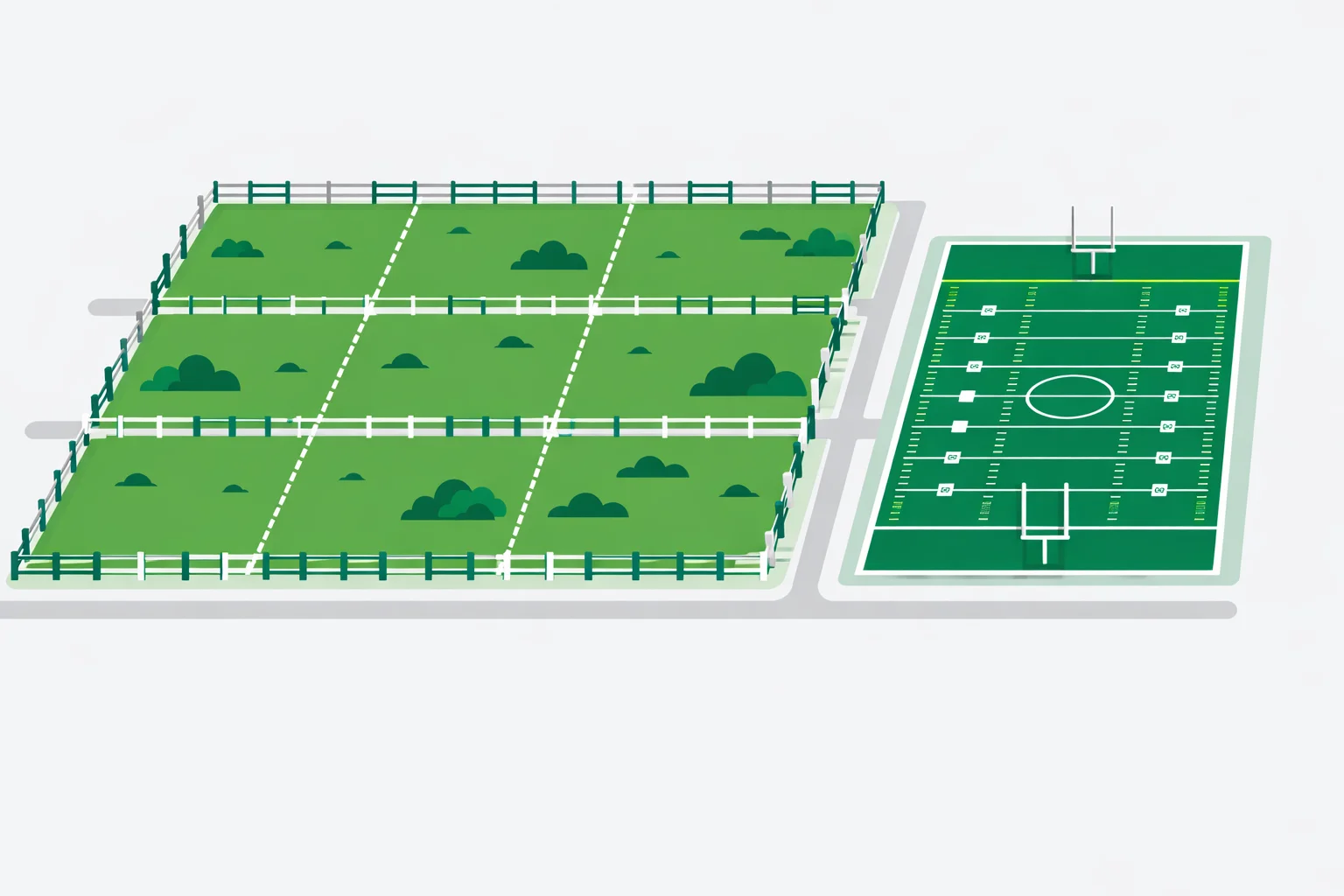
- Football field: An American football field (including end zones) is 57,600 sq ft — about 1.32 acres. So one acre is roughly 75% of a football field.
- Tennis courts: A doubles tennis court is 2,808 sq ft. You could fit about 15.5 doubles tennis courts inside one acre.
- City block: A typical city block varies widely, but in a grid-style city like Manhattan a block is roughly 1.5–2.0 acres.
- Parking lot: At 180 sq ft per space, one acre holds roughly 242 standard parking spaces — comparable to a medium-sized grocery store parking lot.
- Houses: The average new U.S. home sits on about 0.19 acres. That means approximately five typical houses (with yards) fit on one acre.
Common Lot Sizes in Acres
Lot sizes vary significantly by region and zoning. Here is what to expect in different settings:
- Urban lots: 0.05–0.15 acres (2,200–6,500 sq ft). Townhouse and row-house lots in cities like Philadelphia or Baltimore often fall below one-tenth of an acre.
- Suburban lots: 0.15–0.50 acres (6,500–21,780 sq ft). The median suburban lot in the U.S. is about 0.22 acres according to Census data.
- Rural residential: 1–5 acres. County zoning minimums in rural areas often require at least 1 acre per home for septic and well clearances.
- Small farms: 5–50 acres. A 10-acre hobby farm provides enough space for a large garden, a few livestock paddocks, and a small orchard.
- Commercial farms: 100–1,000+ acres. The average U.S. farm is about 445 acres according to USDA data.
If you are evaluating a property listing that shows dimensions in feet, use the area calculator to compute square footage for irregular shapes, then convert to acres by dividing by 43,560.
Acres vs. Hectares: When to Use Each
The hectare is the metric equivalent of the acre, used in most countries outside the U.S. and U.K. One hectare equals exactly 10,000 square meters (about 2.471 acres). Here is a simple decision framework:
- Use acres for U.S. real estate listings, USDA reports, property deeds, and county tax assessments.
- Use hectares for international land transactions, scientific research, environmental surveys, and any context using the metric system.
- Quick conversion: Multiply acres × 0.4047 to get hectares. Multiply hectares × 2.471 to get acres.
A 2-acre lot is about 0.81 hectares. A 1-hectare property is about 2.47 acres — roughly the size of 2.5 football fields. For a land purchase that involves a mortgage, knowing the exact acreage helps lenders and appraisers value the property correctly.
Common Acreage Measurement Mistakes
These errors regularly lead to wrong lot sizes — and sometimes costly real estate disputes:
- Confusing linear feet with square feet:A lot described as "200 × 200" is not 200 square feet — it is 200 × 200 = 40,000 square feet (0.92 acres). This mistake can make a property seem 200× smaller than it actually is.
- Ignoring slopes and elevation: A 1-acre lot on a hillside has more surface area than 1 acre measured on a flat map. Surveyors measure horizontal distance, so a steep half-acre lot might feel noticeably larger once you walk it.
- Using the wrong conversion factor: Some people divide by 4,356 instead of 43,560, ending up 10× too high. Remember: 43,560 sq ft per acre, with a comma after the 43.
- Assuming rectangular lots: Property boundaries often follow roads, rivers, or surveyor lines that create irregular shapes. Always check the plat map from the county recorder rather than assuming the lot is a simple rectangle.
When to Use This Calculator
- Buying or selling land: Verify acreage before making an offer — even a 5% discrepancy on a $100,000 parcel means $5,000 in mispriced value.
- Estimating fencing or clearing costs: A 1-acre square lot needs about 836 linear feet of fencing. This calculator gives you the total area so you can calculate perimeter and material costs.
- Comparing property listings: When one listing shows square footage and another shows acres, convert both to the same unit to make a fair comparison.
- Farm and garden planning: Know your usable acreage to plan crop yields, irrigation, or livestock carrying capacity. USDA guidelines are typically stated per acre.